
Quick answer
Under the Dubai Municipality Food Code, keep chilled high-risk food at 5°C or below and frozen food at -18°C. Hot food for service should stay at 60°C or above. Food left between 5°C and 60°C (the danger zone) has strict time limits: no more than 2 hours for hot food and 4 hours for cold food. Store raw meat, poultry and fish below ready-to-eat food, keep everything at least 15 cm off the floor, label and date it, and use the oldest stock first.
Getting food into your kitchen at the right temperature is only half the job. What happens in your chiller, freezer and dry store over the following days decides whether that stock is safe, how long it lasts and how much of it ends up in the bin.
This guide is written by the team at Haider Ali Foodstuff Trading, a wholesale food supplier at the Al Aweer Fruits & Vegetable Market in Dubai that runs its own cold storage for meat, dairy, frozen and bakery products. It follows on from our chilled and frozen delivery receiving checklist, and covers what to do once a delivery has passed its checks.
Key takeaways
- Chiller at 5°C or below, freezer at -18°C, hot holding at 60°C or above.
- High-risk food should not sit between 5°C and 60°C for more than 2 hours (hot) or 4 hours (cold), including preparation time.
- Store ready-to-eat food above raw meat, poultry and fish, never below.
- Keep food at least 15 cm off the floor, covered, labelled and dated.
- Defrost in the chiller, and cool cooked food quickly before you chill it.
Food storage temperatures at a glance
These are the core temperatures in the Dubai Municipality Food Code. Use them to set your equipment and to train every member of your kitchen team.
| Storage or process | Temperature | Food Code reference |
|---|---|---|
| Chiller and cold room | 5°C or below | Section 3.6.2 |
| Freezer | -18°C | Section 3.6.2 |
| Hot holding for service | 60°C or above | Sections 3.2.10 and 3.6.2 |
| Reheating for hot holding | Above 75°C in the centre, within 1 hour | Section 3.2.13 |
| Cooling cooked food | 60°C to 20°C within 2 hours, then to 5°C within 4 more hours | Section 3.2.11 |
| Thawing raw meat, poultry and fish | In a chiller with air at 10°C or less, food no warmer than 5°C | Section 3.2.7 |
| Dry store | Cool and ventilated, 60–65% relative humidity, or as the label says | Section 3.6.2(b) |
The danger zone and time limits
The Food Code calls 5°C to 60°C the temperature danger zone. Most food-poisoning bacteria grow and multiply quickly in this range, and in a busy UAE kitchen, food passes through it more often than most teams realise: on the pass, on a prep bench, or in a chiller with the door propped open during a delivery.
Section 3.3 of the Code sets clear limits for high-risk food held in the danger zone:
- Hot food: no more than 2 hours between 5°C and 60°C. After that, it must be thrown away.
- Cold food: no more than 4 hours above 5°C, including preparation time. After that, it should be thrown away.
Those clocks do not reset. A tray of chicken that sat on a prep bench for an hour this morning has only part of its time left this afternoon.
How to organise your chiller
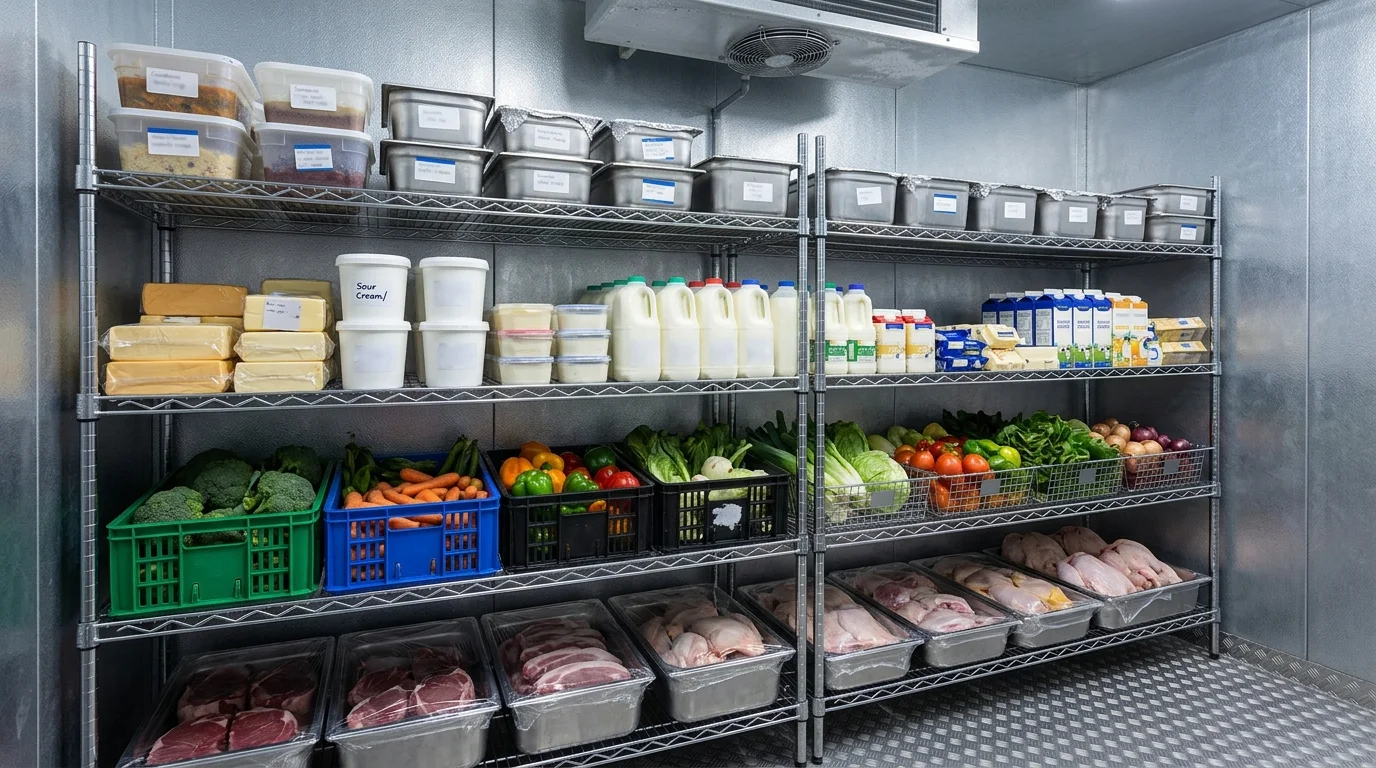
The Food Code says raw and ready-to-eat food should be kept apart, and that ready-to-eat food should never be stored below raw animal products. The simplest way to follow this is to give every shelf a fixed job, from top to bottom:
- Top shelf: ready-to-eat food. Cooked dishes, desserts, sauces, sliced cheese and cooked meats.
- Next: dairy and eggs. Milk, cream, butter, yoghurt and cheese in sealed containers or their original packs.
- Middle: washed fruit and vegetables. Prepared salads and produce that will not be cooked.
- Lower: raw whole cuts of meat and whole fish. In trays or sealed containers that catch any drip.
- Bottom shelf: raw minced meat and raw poultry. These carry the highest risk, so nothing should sit below them.
Keep food at least 15 cm off the floor (section 2.12) and away from walls, so air can circulate and the floor can be cleaned. Do not overload shelves: a packed cold room cannot move cold air around the food, and the stock at the back warms up first.
Freezer storage
The Food Code sets -18°C for frozen storage. At that temperature, bacteria cannot grow, but they are not killed. As the USDA's freezing guidance explains, food kept constantly frozen at this temperature stays safe, but its quality drops the longer it is stored. That is why rotation still matters in the freezer.
Still deciding which meat to keep frozen and which to buy chilled? Our guide to fresh, chilled and frozen meat for restaurants compares the three by shelf life, quality and cost per usable kilo.
- Keep the freezer at -18°C or colder, and check it at least twice a day.
- Wrap or seal food tightly to prevent freezer burn: dry, discoloured patches where the surface has lost moisture.
- Label everything with the product name and the date it went into the freezer.
- Do not refreeze raw meat, poultry or fish once it has thawed. The Code only allows this for specific processes approved by Dubai Municipality.
- Keep ice cream and frozen desserts away from the door, where repeated opening causes partial melting and ice crystals.
- Defrost freezers on a schedule so ice build-up does not reduce cooling.
Dry store and canned food
Rice, flour, pulses, oils, spices and canned food do not need refrigeration, but they still need the right conditions. The Food Code asks for dry stores to be cool and well ventilated, with relative humidity of 60–65%, and for any storage temperature on the label to be followed. Many UAE dry stores sit next to hot kitchens or external walls, so it is worth checking the temperature in summer.
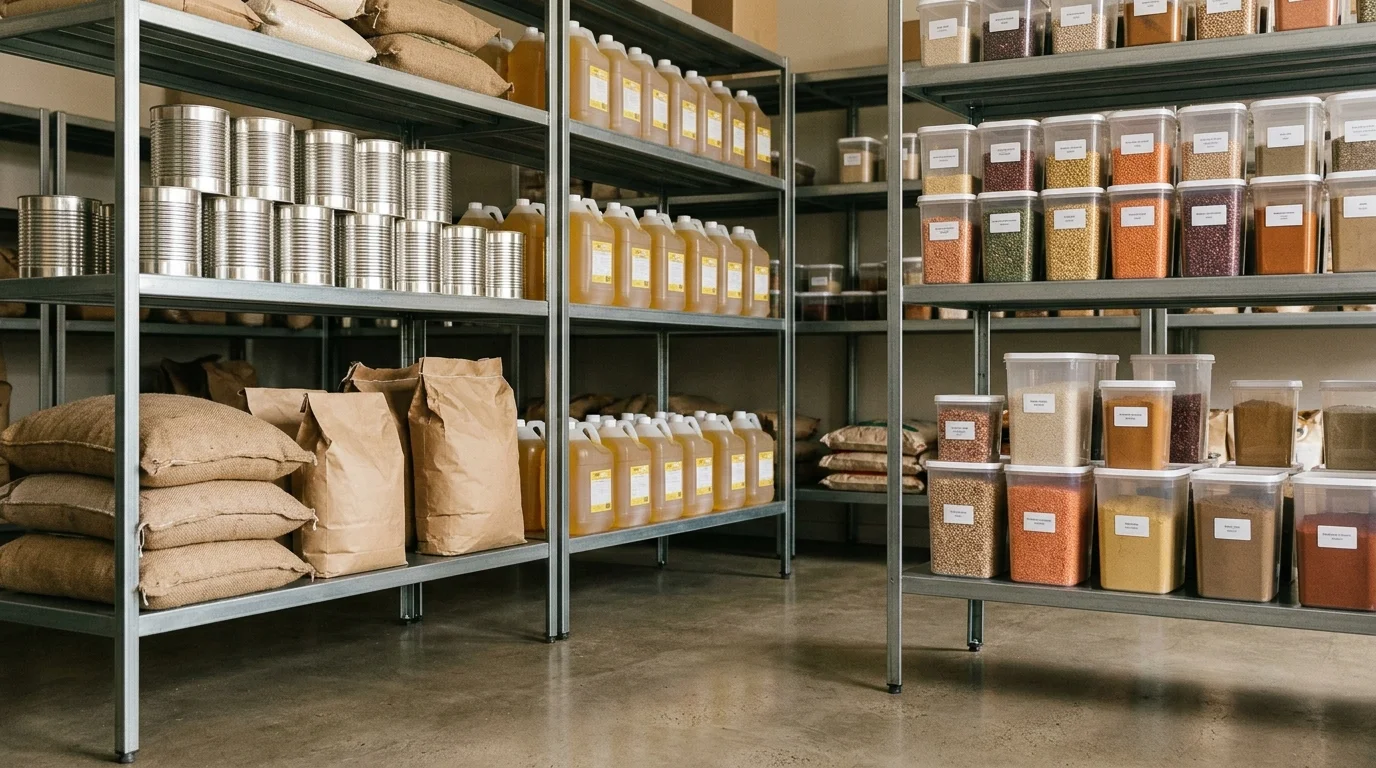
- Store sacks, cartons and cans on shelving or pallets, never directly on the floor.
- Keep opened dry goods in clean, covered, labelled containers to keep out pests and moisture.
- Check cans for swelling, leaks, rust and dented seams before you use them.
- Once a can is opened, move any leftover contents into a covered container and refrigerate them. Do not store food in the open can.
Storage guide by food type
| Food | Where to store | Practical tips |
|---|---|---|
| Fresh meat and poultry | Chiller, 5°C or below, bottom shelves | Keep in trays to catch drip, poultry and mince lowest |
| Frozen meat and seafood | Freezer, -18°C | Keep sealed, label with freezer date, thaw in the chiller |
| Fresh fish and seafood | Chiller, 5°C or below, bottom shelves | Use quickly, keep covered and away from ready-to-eat food |
| Milk, cream, cheese, yoghurt | Chiller, 5°C or below, upper shelves | Keep sealed, check use-by dates, close opened packs |
| Eggs | Chiller, away from ready-to-eat food | Keep in original trays, rotate by date, discard cracked eggs |
| Fresh fruit and vegetables | Chiller for most items | Potatoes, onions and garlic in a cool, dark, dry area |
| Ice cream and frozen desserts | Freezer, -18°C, away from the door | Avoid temperature swings to prevent ice crystals |
| Frozen pastry and dough | Freezer, -18°C | Keep sealed, bake from frozen or thaw as the pack says |
| Canned and dry goods | Cool, ventilated dry store | Off the floor, rotate stock, refrigerate leftovers once opened |
For more detail on how each category is supplied and stored before it reaches you, see our pages on fresh and frozen meat supply, dairy and egg distribution, fruit and vegetable supply, ice cream and frozen desserts, pastry and bakery supply and canned and preserved food.
Buying chilled and frozen stock for your kitchen?
We keep meat, dairy, frozen and bakery products in our own cold stores and deliver them cold across the UAE.
Seven storage rules for every kitchen
Use the oldest stock first
The Food Code asks for stock to be rotated on a "first in, first out" basis. Put new deliveries behind or below older stock of the same item, so the oldest is always picked first. For items with different expiry dates, use the one that expires first.
Label and date everything
Every container in your chiller and freezer should show what it is and when it was made, opened or frozen. If you remove food from its original packaging, the Code says the original production and expiry dates should be copied onto the new label.
Good practice: use colour-coded day labels so anyone in the team can see at a glance what needs using first.
Keep raw food below ready-to-eat food
Drip from raw meat, poultry or fish onto cooked or ready-to-eat food is one of the most common causes of cross-contamination. Follow the shelf order above in every chiller, including small under-counter units on the line.
Cover food and keep it off the floor
Store food in clean, covered containers, at least 15 cm off the floor and away from walls. Cardboard outer cartons collect dirt and pests, so remove them before stock goes into a cold room where possible.
Do not overload your chillers
Cold air needs space to move. Leave gaps between containers and between shelves and walls, and avoid putting large amounts of warm food in at once, which raises the temperature of everything around it.
Thaw frozen food safely
Thaw high-risk frozen food in a way that keeps its warmest part at 5°C or below, and use it within 48 hours of starting to thaw. Raw meat, poultry and fish can be thawed in a chiller with air at 10°C or less, and should be cooked within 72 hours of starting to thaw.
Avoid: thawing on the bench or in a sink of warm water. Thawing outside these conditions needs prior approval from Dubai Municipality's Food Control Department.
Cool cooked food quickly
Cooked food that will be stored should cool from 60°C to 20°C within 2 hours, and then to 5°C or below within the next 4 hours. Divide large batches into shallow containers so they cool faster. Once cooled and chilled, high-risk cooked food should be used within 72 hours of preparation.
Checking and recording storage temperatures
Equipment fails without warning, usually at the worst time. Regular checks catch a struggling chiller before you lose a full cold room of stock. A simple routine works for most kitchens:
- Check every chiller and freezer at least twice a day, for example at opening and before closing, and write down the readings.
- Do not rely only on the built-in display. Check it now and then with a probe thermometer in a glass of water or a sample product kept inside the unit.
- Check your thermometers regularly. The Food Code asks for monitoring equipment to be calibrated at a set frequency. A quick check in iced water should read close to 0°C.
- Act on any reading out of range. Check the door seal, the load and the setting, move high-risk food to another unit, and call for repairs.
| Date | Unit | Opening | Closing | Action taken | Checked by |
|---|---|---|---|---|---|
| 08 Oct | Walk-in chiller | 3°C | 4°C | None | S. Ahmed |
| 08 Oct | Freezer 1 | -19°C | -18°C | None | S. Ahmed |
| 08 Oct | Prep fridge | 4°C | 9°C | Door seal checked, stock moved, repair called | S. Ahmed |
If a chiller or freezer has failed and you do not know how long high-risk food has been above 5°C, or whether frozen food has thawed, do not guess. Throw it away. The Food Code says temperature-abused food should be discarded, and the cost of the stock is far lower than the cost of a food-poisoning case.
Storage starts with your supplier
Good storage habits in your kitchen cannot fix stock that arrived warm or close to expiry. Choose a supplier that stores chilled and frozen food correctly and delivers it in refrigerated vehicles, and check every delivery when it arrives. Our guides on choosing a wholesale food supplier in Dubai and checking chilled and frozen deliveries cover both, and our wholesale food trading service supplies chilled, frozen and dry food in one delivery.
Frequently asked questions
What temperature should a restaurant fridge be in the UAE?
Chillers and cold rooms should keep high-risk food at 5°C or below, under the Dubai Municipality Food Code. Many kitchens set their chillers between 1°C and 4°C to give a margin when the door is opened during service.
What temperature should a commercial freezer be?
The Dubai Food Code sets -18°C for frozen storage. Food kept constantly at this temperature stays safe, but its quality gradually drops, so rotate frozen stock and label it with the date it was frozen.
What is the temperature danger zone?
The temperature danger zone is 5°C to 60°C, the range where most food-poisoning bacteria grow quickly. Under the Dubai Food Code, high-risk hot food should not stay in this range for more than 2 hours, and high-risk cold food for more than 4 hours including preparation time.
How should I store raw meat in a commercial fridge?
Store raw meat, poultry and fish on the bottom shelves in trays or sealed containers, below ready-to-eat food, at 5°C or below. Keep raw poultry and minced meat on the lowest shelf, as they carry the highest risk.
How long can cooked food be kept in the fridge?
Under the Dubai Food Code, cooked high-risk food that has been cooled and chilled should be used within 72 hours of preparation. Label it with the preparation date so your team knows when it must be used.
Can I refreeze meat that has thawed?
Not as a general rule. The Dubai Food Code only allows thawed raw meat, poultry or fish to be refrozen for specific processes with prior approval from Dubai Municipality's Food Control Department. Cook thawed meat instead, within the time limits for thawed food.
Stock your kitchen from one reliable supplier
Haider Ali Foodstuff Trading supplies chilled, frozen and dry food to restaurants, hotels, supermarkets and caterers across the UAE. Send us your list for wholesale prices.
Sources
- Dubai Municipality, Food Code: sections 2.12 (storage height), 3.2.7 (thawing), 3.2.10 (hot holding), 3.2.11 (cooling), 3.2.13 (reheating), 3.3 (time as a safety control), 3.4 (separating raw and ready-to-eat food) and 3.6 (storage and temperature control).
- USDA Food Safety and Inspection Service, Freezing and Food Safety: safety and quality of frozen food over time.