
Quick answer
When a chilled or frozen food delivery arrives in Dubai, check it before you sign. Chilled high-risk food should be at 5°C or below, and frozen food should be hard frozen, with -18°C the storage target. Raw frozen food must not be warmer than -10°C while it is received and moved. Then check the vehicle, packaging, labels, dates and quantities, and put the food into cold storage quickly. Return anything that fails and record it on the delivery note. These checks follow the Dubai Municipality Food Code.
Receiving is the last point where you can refuse a problem before it becomes your problem. Once you sign the delivery note and the cartons go into your cold room, a warm case of chicken or a box of partly thawed prawns is your stock, your food safety risk and your cost.
This checklist is written by the team at Haider Ali Foodstuff Trading, a wholesale food supplier at the Al Aweer Fruits & Vegetable Market in Dubai that delivers chilled and frozen food to restaurants, hotels and supermarkets across the UAE. It expands the delivery section of our guide on how to choose a wholesale food supplier in Dubai, and it explains what we expect our own customers to check when our vans arrive.
Key takeaways
- Check every delivery when it arrives, before you sign. The Dubai Food Code says unacceptable food should be returned and documented.
- Chilled high-risk food should be at 5°C or below. Raw frozen food must not be warmer than -10°C during receiving, and -18°C is the frozen storage target.
- Look for signs of thawing on frozen food, not only the probe reading.
- Move chilled and frozen food into storage quickly. The Code allows only a brief rise of up to 5°C, for no more than 20 minutes, while food is transferred.
- Keep a simple receiving log, and keep invoices and lot codes on file.
Why receiving checks matter
The Dubai Municipality Food Code describes 5°C to 60°C as the temperature danger zone, the range where most food-poisoning bacteria grow and multiply quickly. Chilled meat, poultry, seafood and dairy are high-risk foods, so every minute they spend in a warm van or on a loading bay counts.
The Code puts the responsibility on the receiving business. Section 3.2.3.1 says incoming food should be inspected when it is received, to confirm that:
- food and packaging are free from damage, pests and other contamination;
- the food is in a suitable condition for its intended use;
- the right documents come with it;
- the transport is suitable and approved by the food authority.
Food that fails should be returned and documented, and accepted food should be moved into storage quickly after inspection. A good receiving routine protects your customers, your inspection results and your food cost.
Delivery temperatures at a glance
| Type of food | Target | Dubai Food Code reference |
|---|---|---|
| Chilled high-risk food (meat, poultry, seafood, dairy, ready-to-eat) | 5°C or below | Sections 3.2.3.1 and 3.6.2 |
| Chilled food being moved into storage | A brief rise of up to 5°C allowed, for no more than 20 minutes | Section 3.6.3(d) |
| Raw frozen food during receiving and transfer | No warmer than -10°C | Section 3.6.3(e) |
| Frozen storage | -18°C | Section 3.6.2 |
| Hot food (catering deliveries) | 60°C or above | Sections 3.2.3.1 and 3.6.2 |
| Dry and canned goods | Cool, ventilated storage, or the temperature on the label | Section 3.6.2(b) |
In practice, frozen deliveries in good condition arrive hard frozen, close to -18°C. A reading near -10°C means the cold chain has slipped, even if it is still within the limit.
Before the delivery arrives
Most receiving problems start before the van pulls up: nobody is free to check it, the cold room is full, or the thermometer has no battery. Set up these basics once and receiving takes a few minutes per delivery.
- A clean, working probe thermometer, checked regularly against iced water (about 0°C).
- Sanitising wipes for the probe, so you do not cross-contaminate between raw and ready-to-eat products.
- Space cleared in the chiller and freezer before the delivery window.
- A named person on each shift who checks and signs for deliveries.
- Delivery times agreed with your supplier that avoid lunch and dinner service.
- A receiving log ready, on paper or on a tablet.
- Your purchase order to hand, so you can check quantities and specifications.
The receiving check, step by step
Work through deliveries in this order: chilled and frozen items first, then fresh produce, then dry and canned goods. Temperature-sensitive food should spend the least possible time outside cold storage.
Check the vehicle and the paperwork
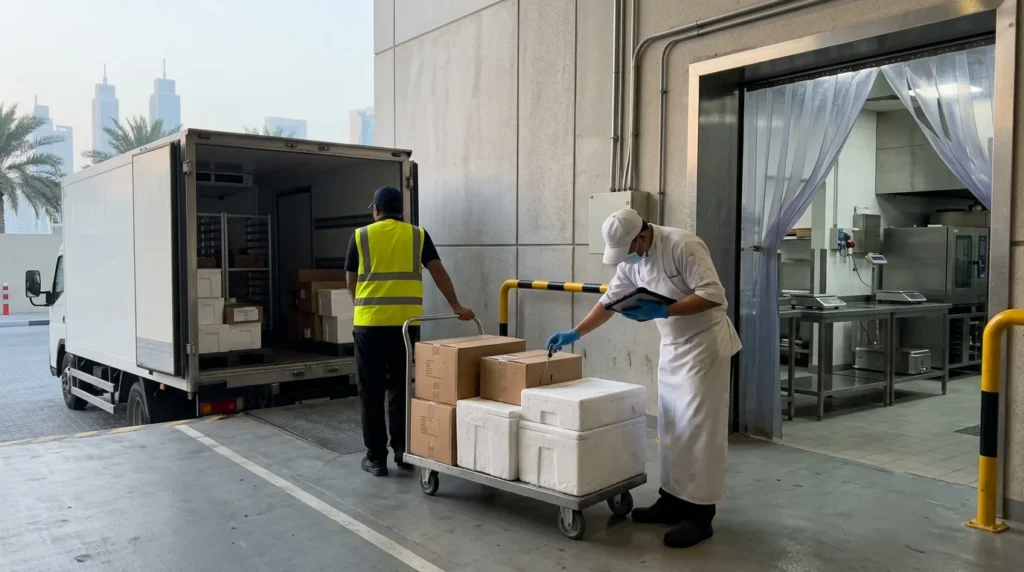
Before anything is unloaded, look inside the vehicle. Chilled and frozen food should travel in a clean, refrigerated vehicle. Section 3.6.1 of the Food Code says food must be transported in vehicles approved by Dubai Municipality's Food Control Department. Check that the delivery note matches your order and names the supplier.
Reject if: chilled or frozen food arrives in an unrefrigerated van, the load compartment is dirty, or raw meat is stacked on top of ready-to-eat food.
Probe chilled food first
Check the temperature of chilled high-risk items as soon as they are unloaded. Take readings from several cartons, including ones from the edge and top of the load, which warm up fastest.
Accept: 5°C or below. If a reading between packs is borderline, sanitise the probe and check the core of one sample product before you decide.
Check frozen food for signs of thawing
Frozen food should be hard to the touch. Press the packs and look for the signs that the product has partly thawed and been refrozen: soft or bendable packs, liquid or frozen drip in the carton, large ice crystals or heavy frost inside the packaging, and blocks of product stuck together.
Reject if: raw frozen food is warmer than -10°C, or shows clear signs of thawing and refreezing, even if the reading looks acceptable.
Inspect packaging, cartons and cans
The Food Code asks for food containers and packages to be intact and free from damage. Check that vacuum packs are still tight, trays are sealed and cartons are dry. For canned food, check seams and lids carefully.
Reject if: packs are torn or leaking, vacuum seals have lost their grip, cartons are wet or crushed, or cans are swollen, leaking, rusted or dented on the seam.
Read the labels, dates and origin
Each product should be labelled with its ingredients and a date code. The Food Code also says the time between delivery and the expiry date should be sufficient for you to use the stock. Agree a minimum remaining shelf life with your supplier for your key items, so "sufficient" means the same thing to both of you.
Also check: the halal certification details on meat and poultry, the country of origin, and that imported products carry the required Arabic labelling.
Check quantity, quality and specification
Count cases and weigh catch-weight items such as meat and fish. Compare them against your order: cut, grade, pack size and brand. Look at quality as well. Meat should have its normal colour and smell, produce should be free from rot and pests, and eggs should be clean and uncracked.
Good practice: agree that substitutions are only made with your approval, and note any shortage on the delivery note before you sign.
Put the food away quickly, in the right order
Move frozen food into the freezer and chilled food into the chiller first, then produce, then dry goods. Rotate stock so the oldest is used first, store food off the floor and away from walls, and keep ready-to-eat food above raw meat, poultry and fish. Our guide to food storage temperatures explains the full shelf order and storage rules.
Why it matters: the Food Code allows chilled food to rise by up to 5°C for no more than 20 minutes during transfer. A delivery left on the floor during service quickly goes past that.
Want chilled and frozen deliveries that pass these checks?
We deliver meat, dairy, frozen and canned food from our cold stores in temperature-controlled vehicles across the UAE.
How to take an accurate probe reading
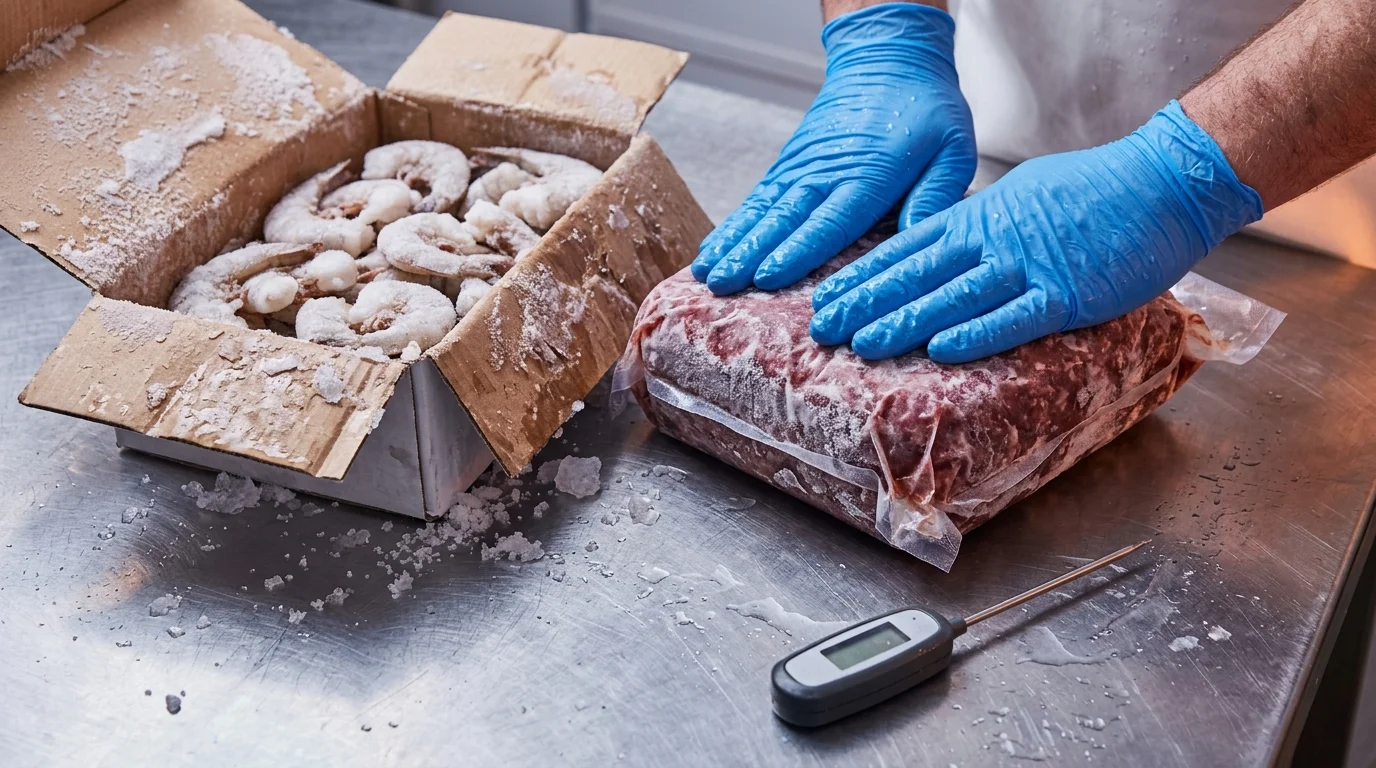
A thermometer is only useful if the reading is right. These habits keep your readings honest:
- Check the thermometer. Place the probe in a cup of crushed ice and water. It should read close to 0°C. If it does not, replace or recalibrate it. The Food Code expects monitoring devices to be accurate and checked at a set interval.
- Probe between packs first. Place the probe tip between two packs and press them together. This does not damage the product, and it is usually enough to accept a delivery.
- Probe the product only when needed. If a between-pack reading is borderline, sanitise the probe and insert it into the centre of one sample item. Keep that item aside and ask your supplier to credit it.
- Wait for the reading to settle. Give the display a few seconds to stop moving before you write it down.
- Clean the probe every time. Wipe it with a food-safe sanitiser between products, especially between raw meat and ready-to-eat food.
When to accept and when to reject
Accept the delivery
- Chilled food at 5°C or below
- Frozen food hard frozen, with no signs of thawing
- Packaging, seals and cans intact
- Labels and date codes present, with enough shelf life left
- Quantities and specifications match your order
Return the item
- Chilled food above 5°C
- Raw frozen food warmer than -10°C, or thawed and refrozen
- Torn packs, broken seals, swollen or leaking cans
- Missing labels, expired stock or very short shelf life
- Signs of pests, off smells or unusual colour
Section 3.6.3 of the Food Code says foods that have been contaminated or subject to temperature abuse should be discarded or disposed of. They should never go into your storage "to use first".
Category checks for common deliveries
Each category has its own warning signs. Use this table alongside the general steps above.
| Category | Check on arrival | Return if |
|---|---|---|
| Fresh meat and poultry | 5°C or below, normal colour and smell, tight vacuum packs, halal details | Warm, sticky or off-smelling, loose vacuum packs |
| Frozen meat and seafood | Hard frozen, no drip or heavy frost, sealed glazing | Soft packs, frozen drip, blocks stuck together |
| Dairy and eggs | Chilled dairy at 5°C or below, sealed lids, clean uncracked eggs | Swollen packs, broken seals, cracked or dirty eggs |
| Ice cream and frozen desserts | Hard frozen, tubs square and sealed | Shrunken or misshapen tubs, ice crystals on the surface |
| Frozen pastry and bread | Hard frozen, pieces separate, cartons dry | Pieces stuck together, wet or crushed cartons |
| Fresh fruit and vegetables | Firm, fresh, correct grade and size, no pests | Rot, mould, heavy bruising, insects |
| Canned and preserved food | Intact cans and jars, readable labels and dates | Swollen, leaking, rusted or seam-dented cans |
For more on how each category is stored and supplied, see our fresh and frozen meat supply, dairy and egg distribution, ice cream and frozen desserts, pastry and bakery supply, fruit and vegetable supply and canned and preserved food pages.
Keep a simple receiving log
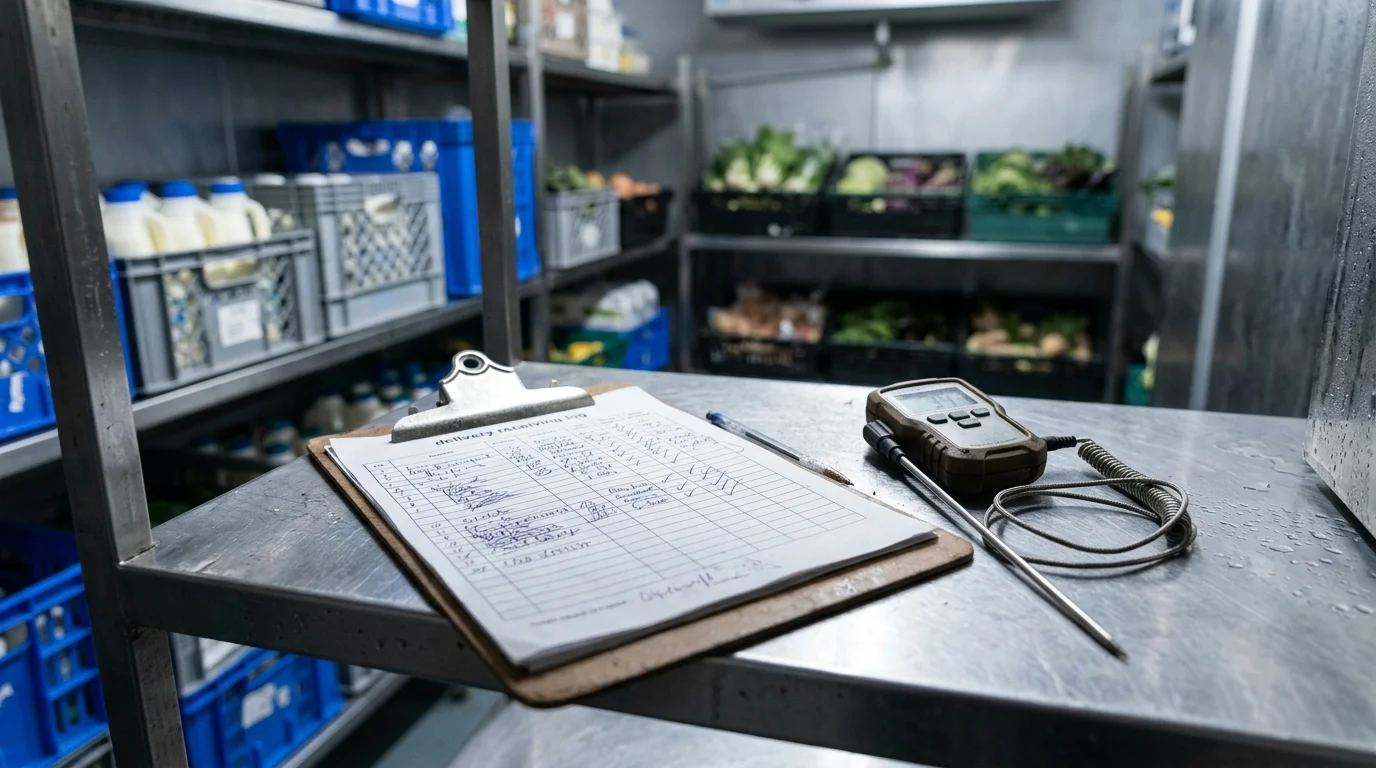
A receiving log shows an inspector, and your own team, that deliveries are checked every time. The Food Code also asks businesses to keep invoices, receipts and lot coding information. One line per delivery is enough:
| Date and time | Supplier and invoice no. | Product | Temp. on arrival | Accepted or returned | Checked by |
|---|---|---|---|---|---|
| 08 Oct, 09:40 | Supplier A, INV-1042 | Chicken breast, fresh | 3.1°C | Accepted | R. Khan |
| 08 Oct, 09:40 | Supplier A, INV-1042 | Prawns, frozen | -17.5°C | Accepted | R. Khan |
| 08 Oct, 09:40 | Supplier A, INV-1042 | Yoghurt 2 kg | 8.4°C | Returned, noted on DN | R. Khan |
When you return an item, write the reason and the temperature on the delivery note, ask the driver to sign it, and take a photo. Send it to your supplier the same day so a credit note or replacement can be arranged quickly.
What your supplier should do on their side
Receiving checks catch problems, but a good supplier prevents them. Before you place regular orders, ask how chilled and frozen stock is stored, how long it spends on the vehicle, and whether you can probe it on arrival. A reliable supplier will:
- keep chilled and frozen stock in cold rooms and freezers until loading;
- deliver in refrigerated vehicles, with frozen and chilled food kept apart;
- plan routes and delivery windows so cold food is not left waiting;
- welcome temperature checks, and replace or credit rejected items without argument.
Our guide to choosing a wholesale food supplier in Dubai lists the questions to ask, and our wholesale food trading service explains how we supply chilled, frozen and dry food in a single delivery.
Frequently asked questions
What temperature should chilled food be when it is delivered?
Chilled high-risk food, such as meat, poultry, seafood and dairy, should be at 5°C or below when it arrives, under the Dubai Municipality Food Code. Check it with a probe thermometer before you sign the delivery note.
What temperature should frozen food be on delivery in Dubai?
The Dubai Food Code sets -18°C for frozen storage and says raw frozen food must not be warmer than -10°C while it is received and transferred. Frozen food in good condition should arrive hard frozen with no signs of thawing.
Can I refuse a food delivery?
Yes. The Food Code says unacceptable food should be returned and documented at delivery. Write the reason and temperature on the delivery note, ask the driver to sign, and inform your supplier the same day.
How do I tell if frozen food has thawed and been refrozen?
Look for soft or bendable packs, liquid or frozen drip in the carton, large ice crystals or heavy frost inside the packaging, and pieces frozen together into a block. Return the product if you see these signs.
How long can chilled food be left out during a delivery?
As short a time as possible. The Dubai Food Code allows chilled food to rise by up to 5°C for no more than 20 minutes while it is moved into cold storage, so check and put away chilled and frozen items first.
What records should I keep for food deliveries?
Keep invoices, receipts and lot code information, as the Food Code asks, plus a simple receiving log showing the date, supplier, product, temperature on arrival, whether it was accepted, and who checked it.
Need a supplier whose deliveries arrive cold?
Haider Ali Foodstuff Trading supplies chilled, frozen and dry food to restaurants, hotels, supermarkets and caterers across the UAE. Send us your list for wholesale prices.
Sources
- Dubai Municipality, Food Code: sections 3.2.3 (food receiving), 3.6.1 (vehicles and monitoring devices), 3.6.2 (temperature control), 3.6.3 (receiving and transfer) and 3.6.4 (storage).
- Dubai Municipality: food safety requirements for food establishments in Dubai.